There is a moment of truth in every home cook’s life that is uniquely devastating. You have spent thirty minutes preparing a batch of healthy oven-fried chicken. You carefully dipped, dredged, and coated. You watched it turn golden brown through the oven window.
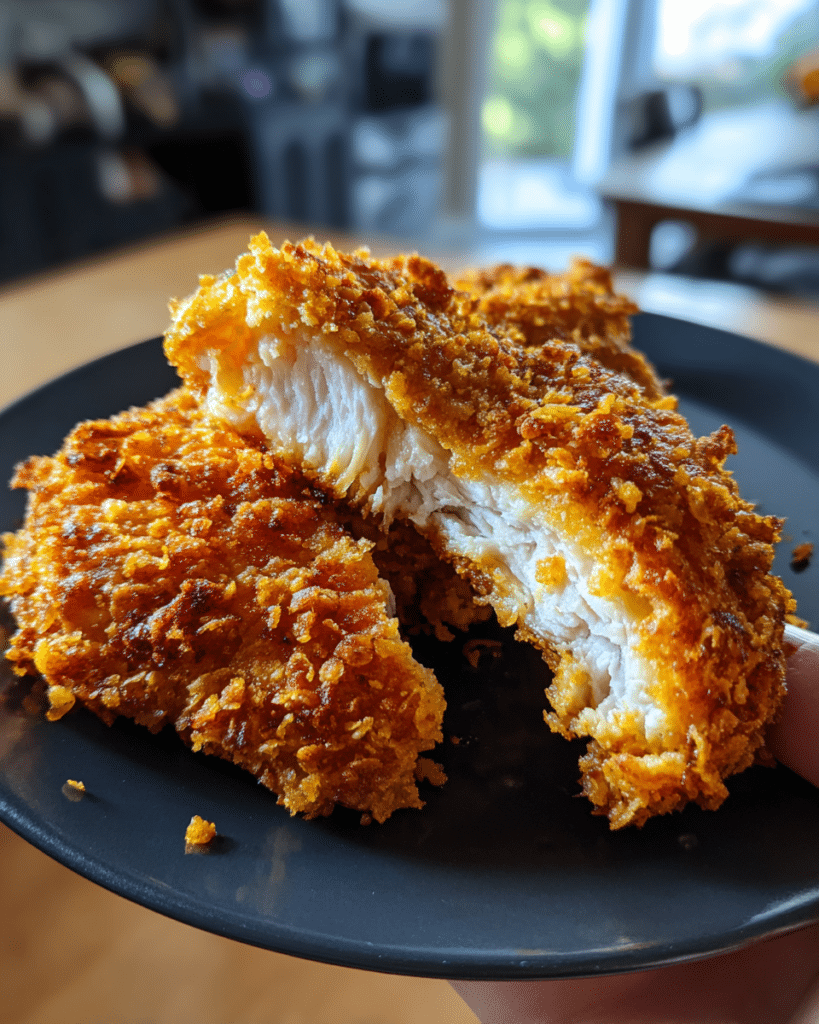
But when you go to lift a piece off the baking sheet, disaster strikes. The golden crust stays stuck to the pan, or worse, it slides off the meat like a loose jacket, leaving you with a pale, steaming piece of naked chicken and a pile of sad crumbs.
This is the “Adhesion Failure,” and it is one of the most common complaints we receive at Crispzy.
Table of Contents
If you are wondering, “Why Breading Falls Off Chicken?” the answer is rarely about the recipe’s flavor profile. It is a failure of structural engineering. You are trying to bond a dry, starch-based crust to a wet, protein-based surface in a high-steam environment.
To fix it, we have to stop cooking and start building. We need to create a chemical bond that is stronger than the steam trying to break it.
The Physics of Failure: Hydroplaning and Steam Lift
To understand how to keep your crust intact, you must first understand the forces trying to destroy it. In the environment of a convection oven, your breading is under attack from two sides.
1. The Hydroplaning Effect
Raw chicken is naturally slippery. It is coated in water and myoglobin. Your coating (usually egg and breadcrumbs) is also wet.
If you apply an egg wash directly to raw chicken, you are essentially trying to put a water-based adhesive on a water-based surface. There is no friction. When the chicken heats up and the proteins contract, the slick egg layer simply slides over the slick meat surface 1. This is culinary hydroplaning.
2. The “Steam Lift” Phenomenon
Just like we discussed in our guide on Why Are My Air Fryer Chips Soggy?, moisture management is critical. When chicken cooks, it releases water vapor.
If your coating is not porous enough, or if it hasn’t bonded chemically to the meat, that escaping steam gets trapped between the chicken skin and the breading. As the pressure builds, the steam inflates, physically pushing the crust away from the meat2. This creates an air gap. Once that gap forms, the breading becomes a separate shell that cracks and falls off at the slightest touch.
The 3-Stage Dredging Matrix
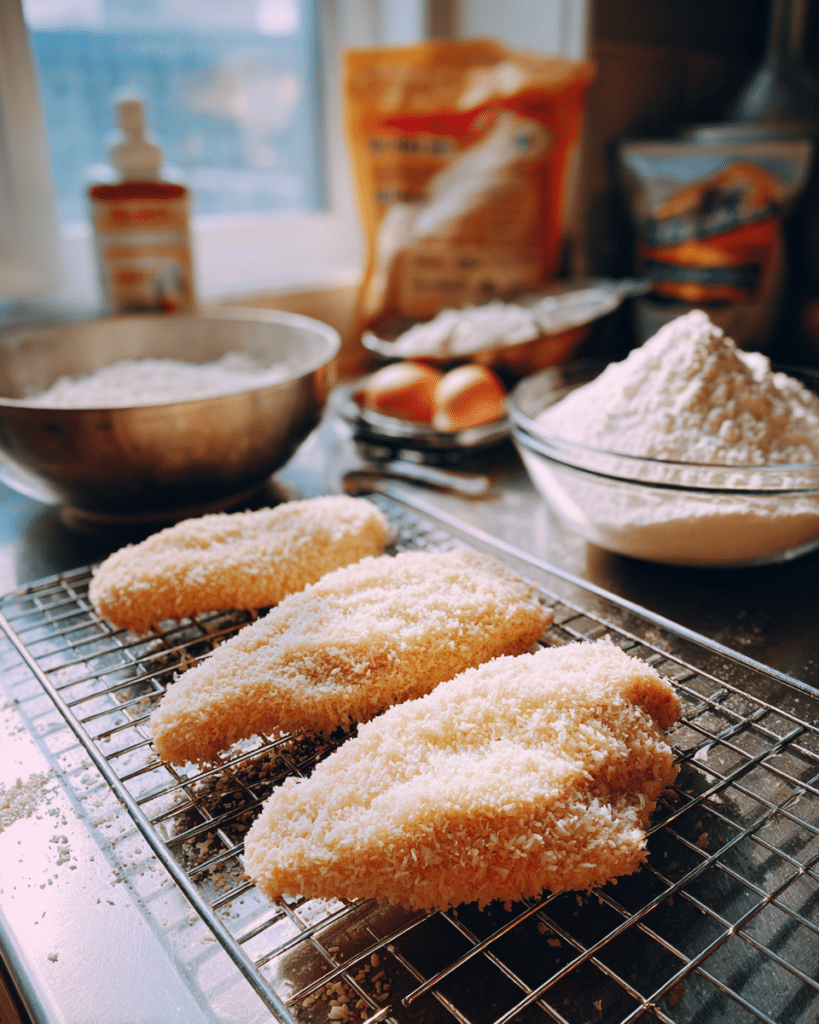
To prevent Why Breading Falls Off Chicken scenarios, you cannot skip steps. You must build a “composite material”—a multi-layered system where each layer chemically bonds to the next.
Research into commercial coating systems identifies the “Three-Stage Dredge” as the only reliable method for adhesion3.
Stage 1: The Dry Anchor (Flour)
This is the step most amateurs skip or rush. You must dry the chicken thoroughly and then coat it in seasoned flour.
- The Science: The flour acts as a primer. It absorbs the surface moisture and myoglobin from the chicken4. By creating a dry, starchy surface, you give the liquid egg wash something to grab onto. Without this dry anchor, the egg has nothing to bond with.
Stage 2: The Protein Glue (Egg Wash)
The egg is your cement. Specifically, the proteins in the egg (ovalbumin) are responsible for the bond.
- The Science: When heated, egg proteins denature and coagulate. If they are intertwined with the flour layer below and the crumb layer above, they solidify into a concrete-like mesh that locks the system together5.
- Technique Note: Beat your eggs thoroughly. You want to break down the albumin strands so the liquid is fluid and uniform6. A thick, gloopy egg wash creates heavy spots that will slide off later.
Stage 3: The Textural Crust (Panko)
The final layer provides the crunch. At Crispzy, we prefer Panko over standard breadcrumbs because of its unique “slivered” structure, which allows for better oil drainage and crisping 7.
- The Science: This layer must be mechanically compressed. Gently rolling the chicken in crumbs isn’t enough. You must press the crumbs firmly into the egg layer with the heel of your hand8. This maximizes the surface area of contact, ensuring the “glue” penetrates the “crust.”
The Missing Link: The “Resting Phase”
If you execute the 3-Stage Dredge perfectly and immediately throw the chicken into the oven, you might still experience Why Breading Falls Off Chicken.
Why? Because you didn’t let the glue dry.
This is the single most important secret in the oven-fried niche, and it is backed by significant food science data: You must rest your breaded chicken.
The 15-Minute Rule
Once your chicken is coated, place it on a wire rack and put it in the refrigerator for 15 to 30 minutes before cooking9.
Why This Works
During this resting period, a process called hydration occurs. The flour layer absorbs moisture from the egg wash and the surface of the meat10.
- Gluten Relaxation: The gluten network in the flour relaxes, allowing it to conform better to the shape of the chicken.
- Solidification: The coating transforms from three separate layers (Flour/Egg/Crumb) into a single cohesive sheath11.
Think of it like painting a wall. If you touch the paint while it’s wet, it smears. If you let it tack up, it becomes durable. The fridge creates this “tacky” state for your breading. When the heat hits it, the coating is already one solid unit, making it much harder for steam to push it off.
The Thermodynamics of the “Soggy Bottom”
Even with perfect adhesion, gravity works against you. In an oven, the bottom of the chicken is in contact with the pan. Trapped moisture here will dissolve your hard-earned bond, causing the bottom crust to detach.
Elevation is Mandatory
To mimic the 360-degree heat of a deep fryer, you must elevate the protein. Using a wire rack placed over a baking sheet is non-negotiable12.
- Airflow: This allows convective hot air to circulate under the chicken13.
- Evaporation: Any moisture releasing from the bottom of the meat can evaporate into the air rather than pooling around the crust.
The “Hot Pan” Conductive Method
If you don’t have a wire rack, use the “Hot Pan” technique. Preheat your baking sheet with oil in the oven until it is scorching hot ($400^{\circ}F+$). When you place the cold, breaded chicken onto the hot metal, the immediate conductive heat transfer “sears” the bottom crust instantly 14. This sets the bond before the juices have a chance to leak out.
Troubleshooting Guide: Diagnosing Adhesion Failure
If you are still seeing bald spots on your dinner, use this diagnostic table to find the flaw in your process.
| Symptom | The Root Cause | The Scientific Fix |
| Breading slides off in one sheet | Hydroplaning: No dry anchor. You likely applied egg directly to wet meat. | Pat chicken bone-dry, then dredge in flour before the egg wash. |
| Crust puffs up and cracks | Steam Lift: Moisture trapped under the skin pushed the crust away. | Score the chicken skin lightly or ensure the flour coating is thorough to absorb steam. |
| Breading dissolves on the bottom | Pooling: The chicken sat in its own juices. | Use a wire rack to allow airflow underneath. |
| Bald spots after cooking | Lack of Hydration: You cooked it too soon. | The Resting Phase: Refrigerate coated chicken for 20 mins to let the “glue” set. |
Conclusion: Engineering the Perfect Golden Crust
Achieving a restaurant-quality crust in a home oven isn’t about luck. It is about respecting the chemistry of adhesion.
When you ask “Why Breading Falls Off Chicken,” remember that you are building a structure. You need a primer (flour), a strong adhesive (egg), and a structural material (Panko). And just like concrete, you need to let it cure (rest).
By adding the “Resting Phase” to your routine and elevating your meat on a rack, you will stop seeing naked chicken and start enjoying the shatteringly crisp, golden-brown dinner you worked so hard to create.
Ready to try this technique?
- Master Recipe: Apply this science to our [Ultimate Oven-Fried Chicken Tenders] (Coming Soon).
- Ingredient Deep Dive: Learn why we use [Panko vs. Breadcrumbs] for maximum crunch.
Happy Crunching — Nour